There are still a few spots available in the Improving Studio Work Through Plein Air workshop held at the Art League in New Braunfels, TX June 8-10. Please check the workshop page on this blog or my website for more information. We will have fun, learn a lot, and don't worry, we WILL stay cool!
Friday, June 1, 2012

Photos from the Flint Hills Workshop, May 3-6, 2012

 |
| We arrived Thursday afternoon and the light was perfect! Everyone got used to their gear and did some warm up painting. |
 |
| Three days together at the bunkhouses - living the artist's life! |
 |
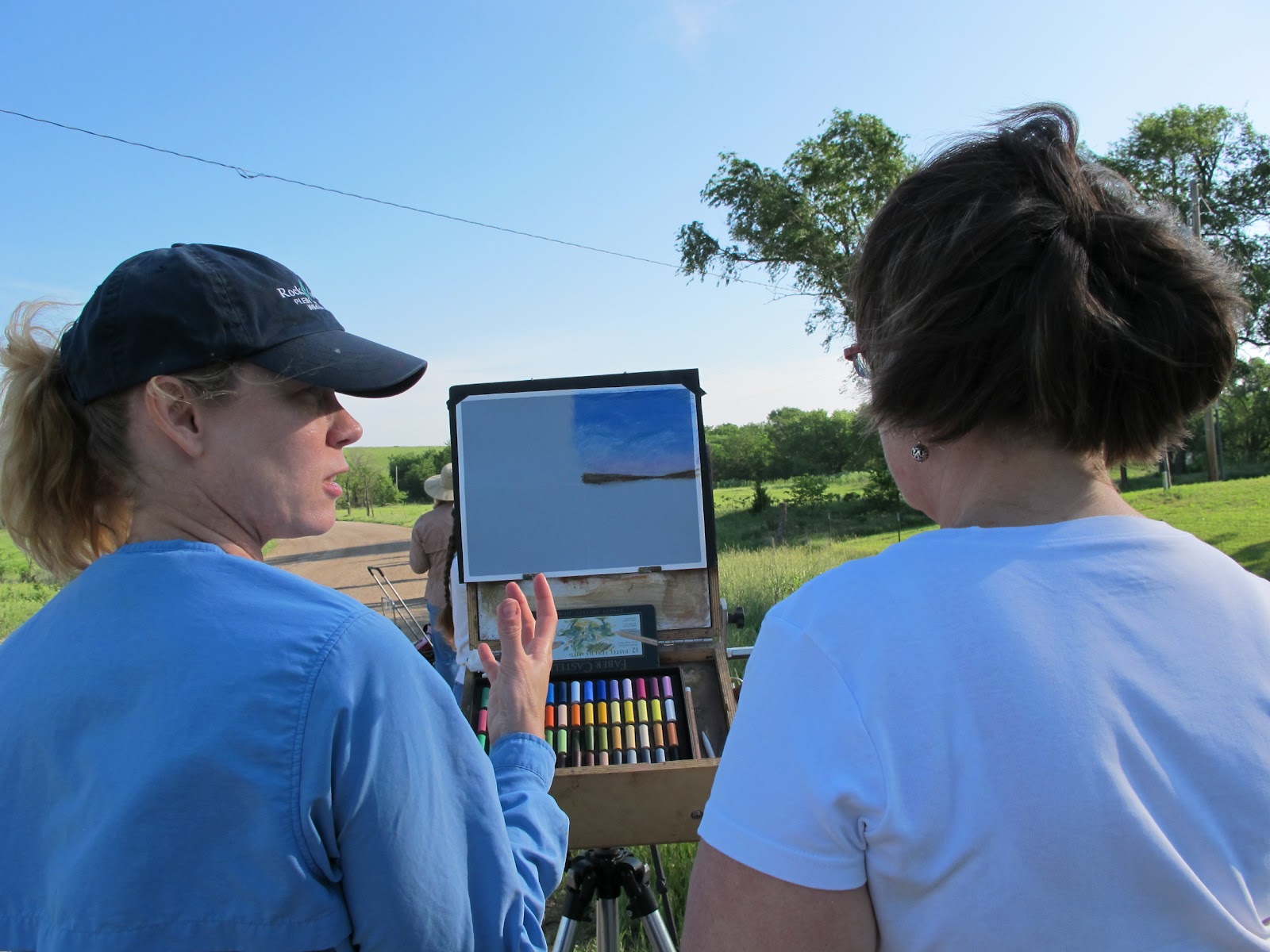
| On Friday morning we got right to it - painting skies. |
 |
| Only a few wispy clouds in the sky, but we made the most of it. |
 |
| It is possible to paint using a limited selection of pastels and layering. |
 |
| Elaine getting started on a beautiful pastel painting. |
 |
| Hmm... why are all those people standing on the road?? |
 |
| And now we paint rocks! |
 |
| It was hot and humid! |
 |
| Friday afternoon we concentrated on painting rocks and water. |

 | |||||||
| The heat didn't slow down these dedicated artists! |

 |
| Saturday morning's beautiful view. |
 |
| Starting the morning demo. |
 |
| Blocking in... |
 |
| and still working on the demo. |
 |
| The cows were very curious! |
 |
| We spent Saturday afternoon finding shade and painting along a wooded road. What beautiful light! |
 |
| Many of the artists spent the evenings photographing. |

 |
| A cattle path near Flyiing W Ranch. |
 |
| It was almost a full moon that evening |
 |
| Pristine prairie. |
 |
| Artists taking photos of artists taking photos! |
 | ||
| The light at dusk was breathtaking. |

 |
| We spent Saturday night having a well deserved dinner at the Grand Central Hotel in Cottonwood Falls - YUM! |
 |
| Clements Stone Arch Bridge near Flying W Ranch |
 |
| Cool truck begging to be painted! Whoever took this pic - please tell me where you found this! |
 |
| Chase County courthouse in Cottonwood Falls at night. |
 |
| Another wonderful weekend in the flint hills comes to an end. |
Tuesday, May 29, 2012
Grand Teton/Yellowstone National Parks Painting Series
I have been hard at work on a new series of paintings that I am very excited about and wanted to share a few of them with you. These pieces focus on both the Grand Teton and Yellowstone National Parks in the northwestern portion of Wyoming. These are all studio pieces based on plein air pieces created during a trip to the Grand Teton National Park last September. I will be adding to this series as I complete work so please check back.
This first piece, A Haven for Many, is a fork of the Snake River which runs through the Grand Teton National Park. This is Schwabacher Landing, a popular spot to view the Tetons. As the title suggests, these types of environments are home to many birds, fish, and other wildlife.
Bradley Lake Shoreline, is a view of Garnet Canyon across Bradley Lake. Bradley Lake is a short hike from Taggart Lake along Taggart Lake trail. I have hiked this trail many times and painted along both the Taggart Lake and the Bradley Lake shorelines.
Fall in the Valley, is a beautiful view of the valley from Willow Flats Overlook in Grand Teton National Park. The light was wonderful on this particular fall evening.
This piece, Mount Moran from Willow Flats, is the same evening in the Willow Flats Overlook area, looking across a portion of Jackson Lake to Mount Moran. I have painted en plein air in the Willow Flats area many times.
The Magic Hour, is an intimate view of the Snake River shoreline in the Grand Teton National Park. The evening light was just, well magical!
This first piece, A Haven for Many, is a fork of the Snake River which runs through the Grand Teton National Park. This is Schwabacher Landing, a popular spot to view the Tetons. As the title suggests, these types of environments are home to many birds, fish, and other wildlife.
 |
| A Haven for Many, oil, 18x24 |
Bradley Lake Shoreline, is a view of Garnet Canyon across Bradley Lake. Bradley Lake is a short hike from Taggart Lake along Taggart Lake trail. I have hiked this trail many times and painted along both the Taggart Lake and the Bradley Lake shorelines.
 |
| Bradley Lake Shoreline, oil, 24x24 |
 |
| Fall in the Valley, oil, 18x24 |
This piece, Mount Moran from Willow Flats, is the same evening in the Willow Flats Overlook area, looking across a portion of Jackson Lake to Mount Moran. I have painted en plein air in the Willow Flats area many times.
 |
| Mount Moran from Willow Flats, oil, 20x24 |
 |
| The Magic Hour, oil, 24x18 |
Tuesday, April 24, 2012
Traveling with Plein Air Gear, Part I
This post will be part of a series on how to travel with your gear.
With the Flint Hills plein air workshop only a week and a half away, and the New Braunfels workshop right around the corner, I thought a post that explained how my plein air set up works would be timely.
There are many questions to ask yourself when packing your gear for plein air, but four main ones come to mind: 1) Medium(s) in which you will work, 2) How you are traveling, ex. driving or flying, 3) Where you are traveling, ex. continental U.S. or international, 4) How are you arriving to painting locations once at your destination, ex. hiking vs. driving. I have experience with many of these situations and will cover them over a period of time. For this post, I will cover traveling with oil paints where one would be driving to the destination and not needing to walk for a very long distance. This covers what I do 80 percent of the time, and will help most of you in most situations.
Start
with a good, roomy pack. One that has a few outer pockets, really good
padded hip belt, comfortable shoulder straps, and made of a durable
nylon. Lightweight stays and ventilating back are good features when
carrying a distance. I use the Kelty Redwing 2900 which is an older
model. Kelty still makes the Redwing because it's very popular. Though
I love my Kelty backpack for carrying purposes, I have my eye on
several good wheeled backpack models from REI that can still be used as
traditional backpacks. Like most artists, I'm constantly trying to
improve my plein air gear. While everything fits great in this pack, it
would be nice to be able to wheel it around when I have that option.
I'm waiting until I can get to an REI store to try them on and see if
they really sit well on the shoulders before I can recommend one.
My
easel set up is the 10x12 palette/panel holder pochade from Open Box M,
mounted to the 190XPROB Manfrotto tripod that Open Box M recommends.
The legs on this tripod can extend beyond what most tripod legs can
handle, allowing for more stability outside on uneven terrain or in
windy situations. Living and painting in Kansas, I'm all too familiar
with windy situations! The 496RC2 ball head on this tripod can hold 13
pounds and has a quick release plate to quickly attach the pochade. I
have a tripod apron attached to the tripod. Sometimes called a stone
bag, you can put a large stone or other heavy objects in it to help
weigh down your set up (also necessary in windy conditions!) I also use
this to put my camera, water bottles or other items you want quick
access to.
I use Raymar's wet panel carriers. I have several traditional wooden boxes, but once these came out, really have had little use for them. I will keep a wooden box in the back of my car when I know I'll have my car close. Unlike the wooden boxes, the Raymar box is lightweight, made out of fluted polypropylene plastic. And unlike the cardboard panel carrier boxes out there, these are waterproof and strong. I can fit an 8x10 or smaller box in my backpack, and keep the larger ones in the car. On a short walk, I can easily carry the 10x12 Raymar box since everything else is inside my pack.
You
can see from this photo that everything I need fits inside my pack or
sits outside in a pocket. Here's a quick run down of what's inside.
Inside the larger compartment:
• 10x12 Open Box M pochade, inside a Hefty 2.5 gal. bag to help slow drying time
• 8x10 Raymar wet panel carrier that holds up to 6 panels
• Rubbermaid container big enough to hold all tubes of oil
• Rubbermaid container that holds small brush washer with mineral spirits
• Small brush case - holds 10 brushes and/or palette knives
• Brass tray that attaches to pochade for holding brushes
• Papertowels
• Breathable rain jacket, Cabela's Dry Plus Ultra with it's own bag.
• Small sketch book
• Car sun visor and two clamps
Inside the middle outer pocket:
• First aid kit with band-aids, instant ice pak,
wrap, alcohol pads, latex-free gloves, etc.
• Multi-tool
• Wet-Ones and small spray bottle for baby oil
• Pencils, small pencil sharpener, erasers
• Clip to attach carabiner with keys, pepper spray and whistle
Inside the small outer pocket:
• Sunscreen
• Bug Spray
• Small wallet
• Cel phone
• Other things you want to get to easily
Outside:
• 2 water bottles in the side pockets
• Tripod slides through the ski slots
• Ball cap velcros to the carry handle
As you might suspect, a lot of thought after many painting experiences have gone into this set up. You can take this list and adapt it to your particular backpack organization.
With the Flint Hills plein air workshop only a week and a half away, and the New Braunfels workshop right around the corner, I thought a post that explained how my plein air set up works would be timely.
There are many questions to ask yourself when packing your gear for plein air, but four main ones come to mind: 1) Medium(s) in which you will work, 2) How you are traveling, ex. driving or flying, 3) Where you are traveling, ex. continental U.S. or international, 4) How are you arriving to painting locations once at your destination, ex. hiking vs. driving. I have experience with many of these situations and will cover them over a period of time. For this post, I will cover traveling with oil paints where one would be driving to the destination and not needing to walk for a very long distance. This covers what I do 80 percent of the time, and will help most of you in most situations.
 |
| Backpack with all gear inside |
 |
| 10x12 pochade on tripod |
I use Raymar's wet panel carriers. I have several traditional wooden boxes, but once these came out, really have had little use for them. I will keep a wooden box in the back of my car when I know I'll have my car close. Unlike the wooden boxes, the Raymar box is lightweight, made out of fluted polypropylene plastic. And unlike the cardboard panel carrier boxes out there, these are waterproof and strong. I can fit an 8x10 or smaller box in my backpack, and keep the larger ones in the car. On a short walk, I can easily carry the 10x12 Raymar box since everything else is inside my pack.
 |
| Main compartment of backpack |
Inside the larger compartment:
• 10x12 Open Box M pochade, inside a Hefty 2.5 gal. bag to help slow drying time
• 8x10 Raymar wet panel carrier that holds up to 6 panels
 |
| Rubbermaid container with oils |
 |
| Rubbermaid container with brush washer |
• Small brush case - holds 10 brushes and/or palette knives
• Brass tray that attaches to pochade for holding brushes
• Papertowels
• Breathable rain jacket, Cabela's Dry Plus Ultra with it's own bag.
• Small sketch book
• Car sun visor and two clamps
 | |||
| Middle compartment |
• First aid kit with band-aids, instant ice pak,
wrap, alcohol pads, latex-free gloves, etc.
• Multi-tool
• Wet-Ones and small spray bottle for baby oil
• Pencils, small pencil sharpener, erasers
• Clip to attach carabiner with keys, pepper spray and whistle
 | ||||
| Small compartment |
• Sunscreen
• Bug Spray
• Small wallet
• Cel phone
• Other things you want to get to easily
Outside:
• 2 water bottles in the side pockets
• Tripod slides through the ski slots
• Ball cap velcros to the carry handle
As you might suspect, a lot of thought after many painting experiences have gone into this set up. You can take this list and adapt it to your particular backpack organization.
 |
| Sun visor shielding pochade |
Wednesday, March 14, 2012
Two New Workshops Announced!
I'm excited to announce two new workshops for September and November of this year. You can find more information about each of these workshops on my website, www.kimcasebeer.com, or on the Workshops page on this blog.
Simplifying the Landscape into Six Parts, will be held at the Wichita Center for the Arts, Wichita, KS in conjunction with the National Small Oil Painting Exhibit. I am honored to judge this exhibit and will hold the workshop September 8 & 9.
This workshop will break down the landscape into: line, shape, value,
temperature of color, intensity of color, and quality of mark
(texture). It’s important to understand each aspect and look at the
landscape in this order BEFORE diving in!
Basic drawing and painting knowledge, otherwise all skill levels accepted. Cost for the workshop is $230 per person. Contact Kathy Sweeney at the school to sign up: school@wcfta.com or 316-634-2787 ext. 219. The Wichita Center for the Arts, Inc., 9112 East Central Ave., Wichita Kansas 67206, www.wcfta.com.
Painting the Landscape in Pastel, Plein Air & Studio will be held at Gravette, AR in conjunction with The Ozark Pastel Society's Juried Show. I am excited to be judging this event and will hold the workshop November 7-9.
This workshop is geared toward the students who wish to take their studio work to the next level. We will work on creating fresh, quick studies outdoors and using those in the studio. This will remind you of the light, atmosphere and excitement of the outdoor experience while also using reference photos to help remember the details.
Basic drawing and painting knowledge, otherwise all skills levels accepted. Cost for the workshop is $295 per person. Contact Annetta Gregory to sign up: artist95@cox.net or 479-524-5494. Mail deposits: 22421 Oakview Road, Siloam Springs, AR 72761. Held Through The Ozark Pastel Society, www.ozarkpastelsociety.org.
Subscribe to:
Posts (Atom)